
The Key Points
-
- People pleasing is not a diagnosis but a learned survival strategy: putting your own needs aside in order to be liked or tolerated and to avoid conflict.
-
- Dr. Robert Glover describes this pattern in men as the “Nice Guy Syndrome”: the man believes he will only be loved if he is good, helpful and no trouble.
-
- The price is high: suppressed anger, silent resentment and loss of self. This can lead to depression.
-
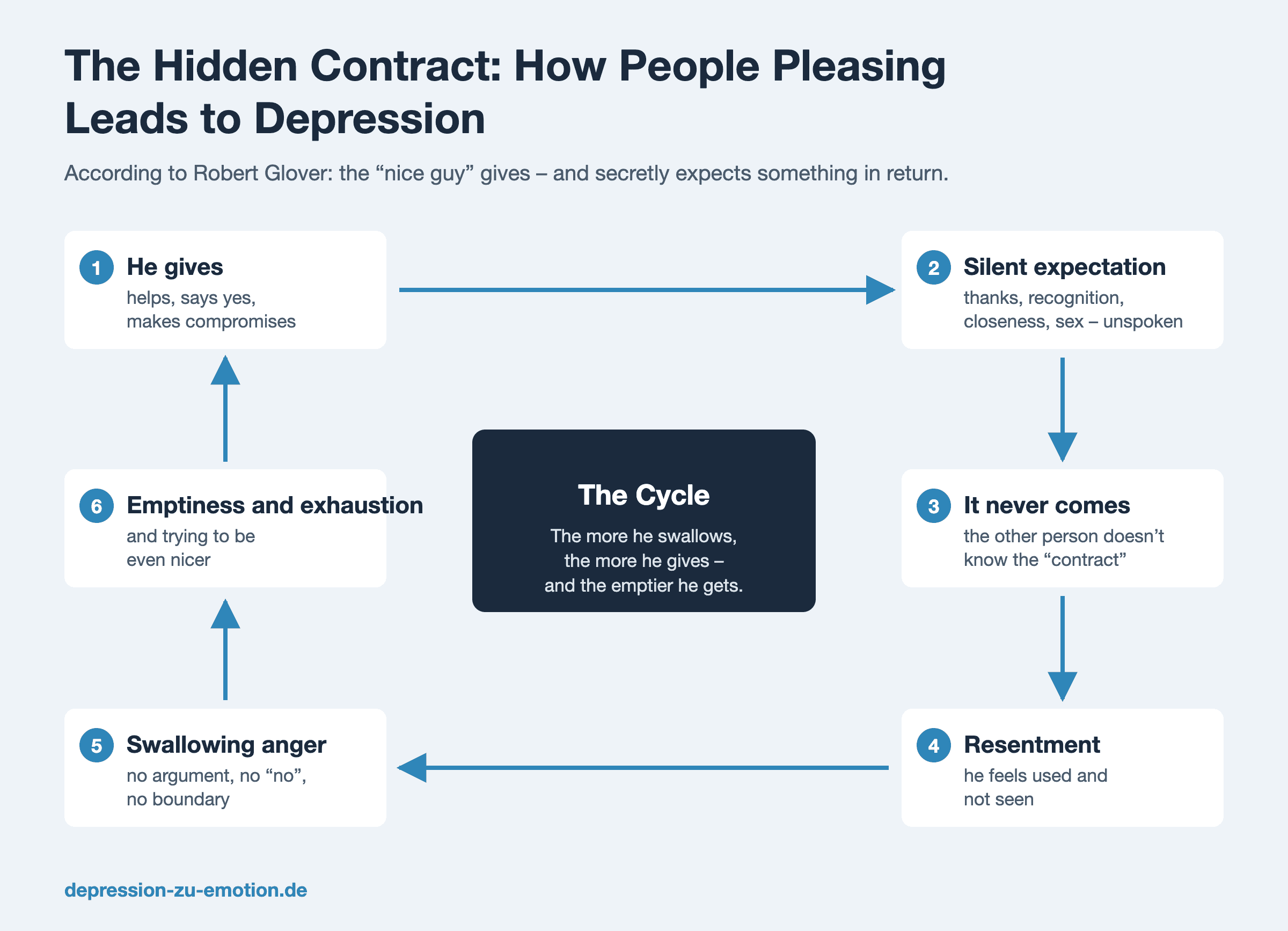
- In relationships, dishonesty and so-called covert contracts arise: you give and secretly expect something back (sex, for example). When what you expected does not come, withdrawal, sarcasm and eventually sudden outbursts follow.
-
- The way out is honesty and courage: feeling your feelings, saying no, voicing your needs. Both can be trained. Giving is fulfilling. But only if it is voluntary and you have the capacity for it!
More and more men come to therapy with a term that hardly existed a few years ago: “people pleaser.” Perhaps you recognize yourself: you always step in at work, rarely say no at home and give in quickly in arguments. From the outside you seem pleasant, reliable, nice. Inside you feel empty, exhausted and often irritable without knowing why. The demands on you become an imposition. You ask yourself angrily why nobody takes your needs into account.
This article is written for men who recognize themselves in this pattern. It explains what is behind people pleasing, why it so often leads to depression and what it does to your relationship.

What This Is About: The “Nice Guy Syndrome” According to Robert Glover
The American family therapist Dr. Robert Glover described this pattern in men in his book “No More Mr. Nice Guy.” At the core, the “Nice Guy” believes: If I am good, if I hide my mistakes and give everyone what they need, then I will be loved, my needs will be met and my life will run without problems.
Behind this attitude, according to Glover, lies a deep shame. Perhaps you too learned early on that you are not okay as you are. That your needs are too much, your anger dangerous and your sadness a burden. So you hide all of that and become “nice.”
Glover’s most uncomfortable observation: Nice Guys are not as nice as they seem. They are often dishonest because they hide their true feelings. And they rarely give unconditionally. Glover speaks of covert contracts: “I do something for you, and in return you give me what I need,” except that the other person knows nothing about this contract. When it is not fulfilled, resentment arises.
Where the Nice Guy Comes From: The Typical Family Background
No man is born a Nice Guy (from here on we use this term instead of people pleaser). In therapy I hear strikingly similar stories: the mother was overwhelmed, lonely or needy herself, and the boy became her confidant or helper early on. A very ambivalent role. On the one hand the boy is “honored” by it, on the other hand overwhelmed. The father was absent or passive, or dominant and unpredictable, so the boy could not orient himself by him. The boy was the “good child” who caused no problems, and was praised for exactly that. He was a kind of buffer for the overwhelmed family system.
There was a lack of emotional “containment”. His feelings were either invalidated (“It’s really not that bad.”) or led to overwhelm (“Oh my God, this too, we have to solve your problem quickly, what can we do?!”). So feelings are a problem. That is why Nice Guys get so nervous when there is a problem. It has to be “made to go away” immediately, which is unbearable for women. That is why Nice Guys rarely listen all the way. They process only intellectually, in terms of problem-solving; in their head they were already working while the woman had not yet finished speaking.
The high level of conflict tension in the household also taught him that under no circumstances could more conflict be added. Confrontations were dangerous. One spark could set everything on fire.
What was once a way to survive becomes a prison in adult life. You learned to read other people’s moods before you feel your own. You locked your anger away because it had no place in the family. Without a male role model who shows how to set boundaries and endure conflict, the experience that relationships survive arguments is missing. That is why you avoid friction, in your relationship and at work too. What matters to me: this is not about blame. Most parents did what they could. But as a grown man you are allowed to renegotiate the old contract with the world.
The Shadow of the Nice Guy
The psychologist C. G. Jung called everything we do not want to see in ourselves, and therefore lock away, the “shadow.” In the Nice Guy, the shadow consists of everything that does not fit his image of the good man: anger, assertiveness, desire, stubbornness and the wish to take for once instead of only giving. These parts do not disappear, they go underground.
The counterpart of the Nice Guy is therefore not the strong man but the alpha male, who takes what he wants like a predator: dominant, ruthless, ready to use others. Figures in the “manosphere” sell exactly this image as “real masculinity” to millions of young men. In my work I suspect that the following of such figures and the number of over-adapted, insecure men are connected. Someone who never learned to say no and to feel his strength looks for a counter-figure. The loud version then feels like a liberating blow, but it is only the other side of the same coin: neither has access to a calm, connected strength. Someone who is strong has no need to announce his strength on YouTube over and over.
Our society also contributes. When boys are quickly seen as “aggressive” for roughhousing and romping, when competition, noise and testing limits are stopped immediately, they learn that their energy is dangerous. Research on rough-and-tumble play suggests that children learn through it to measure their strength, sense boundaries and endure conflict. Add overprotective parents who keep every bit of friction away from their sons. The boy draws the conclusion: my strength is a problem, adapting is safe. That does not mean every caution is wrong. But anyone who trains the wildness out of children may later get either over-adapted or derailed men.
There is an inability in society to differentiate earned, responsible leadership from exploitative command and coercion. The latter defined the patriarchal suppression of women for milennia. Consequently, a suppression of aggression in men started to look very desirable. If the woman calls the shots, she can feel safe. She will not be suppressed, which is a very understandable idea. Leadership, however, is something entirely different. It is responsibility, given freely by those in the care of the leader. A captain on a ship is a fair example. A leader works hard for others. He earns their trust with competence, reliability, and by looking out for the well-being of those he leads. He is also not afraid to step back if he cannot do the job well on a given day or someone else is better suited. Leadership can vary from situation to situation. The captain on the ship might not be the lead chef in the kitchen. I have observed in some women, however, a compulsion to be in charge of everything, including areas their partner simply has far greater competence. This is for me one of the uglier Nice Guy partnership dynamics.
The way forward is what Robert Glover calls this the “integrated man”: he can give and take, be empathetic and say no, allow closeness and set boundaries. To get there you do not have to fight your shadow but get to know it. Anger shows you where a boundary was violated. Assertiveness helps you stand up for yourself and for others. With these parts you do not have to become a tyrant. You become more reliable, more tangible and, for your partner, desirable again too.
Self-Test for Men: How Strong Is Your People Pleasing?
Tick what applies to you. Answer spontaneously and honestly; nobody but you sees the result.
Statements that apply: 0 of 10
Few signs: you seem to be able to set boundaries well and represent your needs.
Why People Pleasing Can Lead to Depression

Suppressed anger turns inward. Someone who never says no accumulates anger. You feel like a victim of other people’s demands. This anger does not disappear, it is just not shown. It shows up as irritability, cynicism, exhaustion and finally paralysis. In my work I experience again and again: underneath the depression lies an anger that was never allowed to be. The physician Gabor Maté describes in “When the Body Says No” how the inability to say no and the chronic suppression of anger become a permanent burden of stress.
A very common therapeutic question is therefore: “When do you say yes while your body says no?”
Loss of self: Someone who has only listened outward for years loses access to himself. Many men say in the first session: “I don’t actually know what I want.” Without wishes of one’s own, drive is missing. That is exactly what then feels like depression!
What This Does to Your Relationship (and the Woman’s Share)

At the beginning of a relationship, as a Nice Guy you are often a balm: attentive, caring, helpful, and you always want the same as your partner. Over time the dynamic degrades, usually gradually.
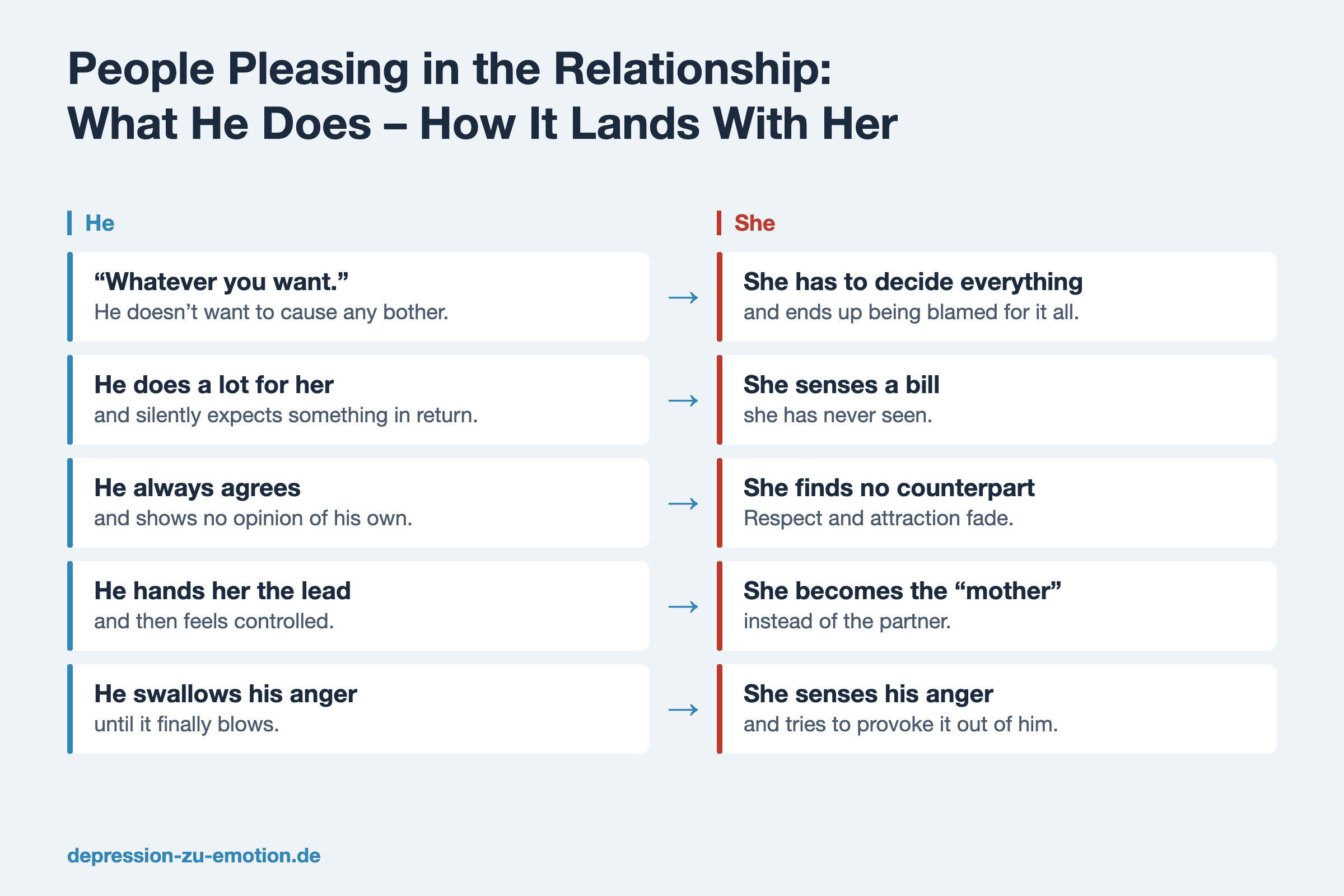
Unfulfilled covert contracts poison everyday life. You tidy up, organize, listen for a long time, and in return silently expect gratitude, closeness or sex. In the phase of falling in love you got all of that! You were also more dynamic, braver and more confident then. Because you never voice your expectations, they can rarely be fulfilled. You feel exploited and unseen. Your partner does not understand why you are hurt.
Your partner has to decide everything. “Where shall we go to eat?” – “Whatever, as you like.” What seems considerate to you becomes a burden for your partner. She carries the responsibility for every decision, and in the end she is also to blame for everything. Many partners describe feeling alone in the relationship even though their partner is always there. In a conflict with the landlord, it is then the woman who has to take charge.
The attraction fades. Glover describes that partners lose respect and desire when they sense that a man does not show himself. This can go as far as contempt. Closeness needs a counterpart with his own opinion, his own boundaries and wishes. A man who always agrees is hard to grasp.
A mother–son dynamic develops. Your partner increasingly takes the lead, you feel controlled and withdraw. Both are dissatisfied. Your partner provokes in order to feel you. Many partners notice that behind the friendliness there is anger that you do not show. Then your partner tries to draw you out: with pointed remarks, with criticism of small things, with arguments about almost nothing. Usually there is no wish to hurt behind this. Your partner is looking for a real counterpart and wants to know whether you are really there. As a Nice Guy you experience this as an attack, withdraw even further or give in, and so the cycle starts over. It would be more helpful to voice your anger early, before it builds up.
At some point it boils over: as an outburst over something trivial, as an affair or as a sudden separation that comes out of the blue for your partner. Or you disappear inside: you work more, drink more, go quiet. These are exactly the signals through which depression in men often shows.
What Helps
The goal is not to become ruthless. Glover speaks of the “integrated man”: a man who can be friendly and still stand up for himself. Above all, five things are needed for this.
Feeling and channeling your feelings, especially anger. Anger is not a destructive force but energy that can take hold. Someone who learns to perceive anger in the body and to express it in a controlled way also finds access to vitality and desire again. You surely know the famous “That’s enough!” moment, where anger motivates you to do or dare something you had long put off (out of fear).
Practice small noes. The psychologist Aziz Gazipura recommends in “Not Nice” starting with small, harmless situations: declining an invitation, voicing a differing opinion. Each no shows the nervous system: I survive this. In therapy we train being able to feel the arising feelings of fear and shame and to let them pass through. They can then be “enclosed” with courage in the body. Over time it gets easier. A plan is good for this. A ranking of such situations from easy to hard is helpful, because you can start with the easier things. Then it begins to be fun.
Bring covert contracts into the open. Instead of giving and waiting, say what you want and what you do not want. This feels vulnerable. But only this way can the other person say yes at all.
Quality over quantity. What you do for others, you do well and gladly.
Define and pursue your own goals. This helps you experience yourself as effective again instead of reactive. If you go bouldering with friends two evenings a week, then sign up for competitions, get better and stronger, that already changes quite a lot. Someone who stays at home “for her” becomes boring and dissatisfied.
By the way, the reason I specialized in men is that most therapists are women. The man-to-man combination has the potential not only of a different understanding but also of a role-model function.
Conclusion
Being nice is not the problem. The problem is only being allowed to be nice. Only someone who can say no can also say yes wholeheartedly, in the relationship, at work and with yourself.
---
A depression is a serious illness and should always be medically assessed as well. If you are thinking about suicide or are in an acute crisis, please contact the emergency number 112 or the Telefonseelsorge (telephone counseling) at 0800 111 0 111 or 0800 111 0 222 (free, around the clock).
Sources
-
- Braiker, H. B. (2001). The Disease to Please: Curing the People-Pleasing Syndrome. McGraw-Hill.
-
- Gazipura, A. (2017). Not Nice: Stop People Pleasing, Staying Silent, & Feeling Guilty. B.C. Allen Publishing.
-
- Glover, R. A. (2003). No More Mr. Nice Guy! A Proven Plan for Getting What You Want in Love, Sex, and Life. Running Press.
-
- Maté, G. (2003). When the Body Says No: The Cost of Hidden Stress. Knopf Canada.
-
- Ussher, J. M. & Perz, J. (2010). Gender differences in self-silencing and psychological distress in informal cancer carers. Psychology of Women Quarterly, 34(2), 228–242. https://doi.org/10.1111/j.1471-6402.2010.01564.x