
A crisis rarely comes out of nowhere. Usually it is the result of changes that were long overdue and never made. The midlife crisis is one of those moments: in their mid-40s or early 50s, many men start to question their whole life, their career, their relationship, their goals. Typical signs are inner restlessness, emptiness, irritability and the urge to change everything radically. It is not an illness. But if the low mood lasts for weeks and joy in almost everything fades, a depression may be behind it. This article asks what a crisis actually is, what it is trying to tell you and how something new can grow out of the collapse of the old.
In acute crisis? If you are thinking about ending your life, call emergency services right away (112 in Germany and across the EU) or, in Germany, the TelefonSeelsorge: 0800 111 0 111 or 0800 111 0 222 (free, 24/7).
Key points
- A crisis is often the result of changes that were put off for a long time. What is not changed voluntarily eventually collapses.
- “Midlife crisis” is not a medical term. But large studies show that life satisfaction for many people is lowest in midlife and rises again afterwards.
- The crisis is also an opportunity: many men go on to build a life that suits them better.
- The most common mistake is to follow the first impulses too quickly.
- Ongoing emptiness, joylessness and exhaustion for more than two weeks point more towards depression. That should be checked by a doctor.
What a crisis actually is
The word crisis comes from the Greek krísis and means decision, turning point. So a crisis is not simply a misfortune that befalls us. It is the moment when something has to be decided.
As I understand it, a crisis is the result of changes that would have been necessary for a long time and were never made. The job that hasn’t fit for years. The relationship in which you only live side by side. Your own wishes that you always postponed until later. Every day, the gap between the life you lead and the life you actually want to lead grows a little wider.
You can picture it like tectonic plates. They shift imperceptibly, year after year, and the tension builds up without much being visible on the surface. Until it is released in an earthquake. Then, within a short time, what seemed stable for decades collapses: the marriage, the career, the image you had of yourself. From the outside it looks sudden. On the inside it was coming for a long time.
That is painful. But this collapse also holds the opportunity of the crisis: where the old no longer stands, something new can be built. Something that fits better with the person you have become.

A model for the process: Alpha, Beta, Gamma, Delta
The German coach and author Veit Lindau describes crises as part of a natural process of transformation, drawing on systems theory (podcast “Metanoia: Dein heilsamer Weg aus der Krise”, in German). I find his model helpful because it shows that a crisis is not the end but a phase.
- Alpha phase: A new level has been reached. Life flows, you feel secure and have things under control.
- Beta phase: Over time, things get tight. What once fitted feels worn out, motivation drops. Most people react with resistance or distract themselves. If the signals are ignored, the “impacts” come closer.
- Gamma phase: Chaos breaks out: a breakdown, a separation, a burnout. This is the actual crisis.
- Delta phase: the pseudo-solutions. Instead of going through the crisis, many reach for quick ways out: the affair, more alcohol, even more work, the rash resignation. That brings brief relief but solves nothing. The tension remains, and the crisis comes back.
At this point, according to Lindau, there are two paths: regression to an old, simpler form, or transformation into something new. Those who take the second path reach a new Alpha phase, on a different level than before.
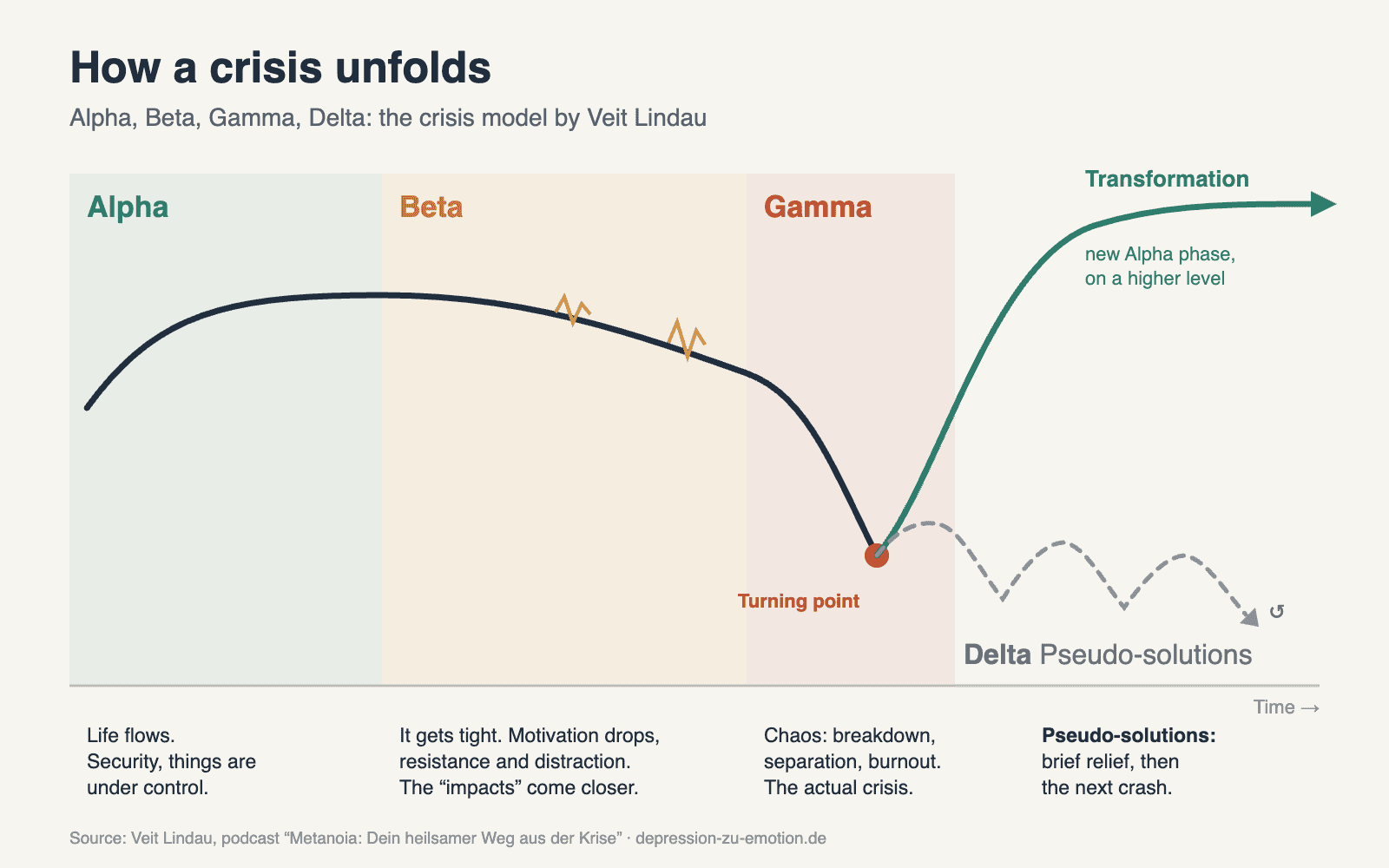
The midlife crisis is often a Gamma phase after a very long Beta phase. Many men have felt the tightness for years and pushed it aside. The longer the Beta phase lasts, the more violent the quake tends to be.
Why midlife of all times?
“Midlife crisis” is not a medical term. Yet the word describes something real. The economist David Blanchflower showed, using data from 145 countries, that well-being follows a U-curve over the course of life: it falls until about the late 40s and then rises again (Blanchflower, 2021).
A lot comes together in midlife. The first half of life is often devoted to building: career, family, house. In my work I see the same pattern again and again in men at this stage. They have functioned for twenty years. What they wanted themselves, what angered, hurt or saddened them, they pushed aside. At the same time, it becomes noticeable that time is limited: parents grow old, children leave, the body starts to make itself heard. The question “Was that it?” can no longer be pushed away.

Men who always wanted to please everyone are especially affected, see People Pleasing: When the Nice Guy Becomes Depressed. Anyone who said yes for years when he meant no often faces the question in his mid-40s of whose life he is actually living. The feelings that had no room for so long then make themselves felt: as anger at the boss, as longing for a different life, as grief over what was never lived.
Typical signs in men
- Questions of meaning: “Was that it?” “What am I actually doing this for?”
- Inner restlessness: the feeling that time is running out
- Irritability: small things at home and at work set you off
- Withdrawal: less desire for friends, your partner, shared plans
- Impulsive outbursts: quitting, an affair, expensive purchases, extreme sports
- Looking back with regret: at paths not taken, missed chances
- Physical signals: sleep problems, exhaustion, declining desire
Many of these signs are normal if they come and go. It becomes important when they settle in.
Midlife crisis or depression?
| Midlife crisis | Depression | |
|---|---|---|
| Mood | fluctuates, restlessness, longing | persistently low or empty |
| Energy | often drive, a wish for change | lack of drive, exhaustion |
| Joy | still there for new things | hardly any for anything |
| Outlook | “I still want to experience something” | “Nothing makes sense anymore” |
| Duration | phases, often changing over months | at least two weeks, almost daily |
| Classification | a phase of life | an illness that needs treatment |
The boundaries are fluid. In men, depression also often shows up differently than expected. The German Depression Foundation (Stiftung Deutsche Depressionshilfe) describes that men more often show “atypical symptoms”, including irritable or aggressive behaviour and reaching more often for alcohol, cigarettes and other drugs (Deutsche Depressionshilfe). So what looks like a midlife crisis can also be a depression. How depression shows up in men, where it comes from and what helps is explained in the guide Depression in Men.
The opportunity: building a new life
A crisis destroys. But it also clears things out. I have seen clients build a radically new and better life after their divorce: with work that truly fulfils them, with relationships in which they can be honest, with an everyday life that suits them. One client of mine wanted to start a new life in Australia with his wife. Out of the grey German everyday routine. When that didn’t work out, the divorce followed. For a long time afterwards he withdrew. But then I watched him emerge like a butterfly from its cocoon, with a completely different presence. He began to live with impressive spontaneity, enthusiasm and sociability. His whole marketing changed too. Instead of a company, he built an experience-oriented community, with boundless enthusiasm.

What matters is how you go through the crisis. Those who really feel the pain, the anger and the grief instead of numbing them usually find beneath them a clear answer to the question of what they actually want.
The most common mistake: following impulses too quickly
The impulse is understandable: quit, separate, sell the house, start everything anew. Anyone who changed too little for years now wants to change everything at once. Sometimes a radical change is right. But mistakes often happen because men follow their first impulses too quickly. The affair, the rash resignation are then more of an escape from the feeling than an answer to it. And the old patterns move into the new life with you.
An impulse wants relief, and it wants it now. Real change comes when you first understand what the crisis is trying to tell you. That takes time, honesty and often someone to talk to. If there is a depression, this applies all the more: the German Depression Foundation explicitly advises postponing important decisions where possible, because those affected see reality through “depressive glasses” (Tips for relatives, in German).
Feel and understand first, then decide. That is not hesitation, but the difference between a real new beginning and a repeat of the old in a new setting.
Self-check: five questions to ask yourself
- Have I felt empty or low almost every day for weeks?
- Have I lost interest in things that used to give me joy?
- Am I much more irritable than before, especially at home?
- Do I drink or work more so as not to feel anything?
- Do I think that nothing makes sense anymore?
If you answer yes to two or more questions, take the detailed depression self-test for men. It takes about three minutes.
What helps now
- Take an honest look. Write down what you have put on hold in recent years: wishes, anger, grief.
- Talk about it. With your partner, a friend, a professional. Many men go through the crisis alone, even though others feel exactly the same.
- Allow feelings instead of pushing them away. Anger and grief lose pressure when you notice them instead of working against them.
- Rule out physical causes. Exhaustion and listlessness can also have physical reasons. Your GP is a good first point of contact.
- Postpone big decisions. Understand first, then act.
For partners
Often the partner is the first to sense that something is wrong, and she takes the distance personally. The partner test and the article Depression in Men: What Partners Need to Know help to make sense of his behaviour.
Frequently asked questions
When does the midlife crisis start in men? Usually between 40 and 55. Studies on life satisfaction show the low point for many people towards the end of their 40s. There is no fixed point in time. Often events trigger the crisis, such as a milestone birthday, problems at work, children moving out or the death of a parent.
How long does a midlife crisis last? It varies a lot, often from a few months to a few years. What matters is whether you take the questions that come up seriously. Those who push them away usually carry them around for longer. If the low mood lasts for weeks, you should have a depression checked by a doctor.
Is a midlife crisis a depression? No. The midlife crisis is a phase of life, not a diagnosis. But the two can come together. If emptiness, joylessness and lack of drive are present almost every day for at least two weeks, that points more towards depression.
What can I do as his partner? Address what you observe, without reproach and without a diagnosis. Don’t take his distance personally and take good care of yourself. If you suspect depression, encourage him to seek medical advice.
Does therapy help with a midlife crisis? For many men, a conversation with a professional is the first place where they speak openly about their doubts. In a free trial session you can find out whether my way of working suits you.
Sources
- Blanchflower, D. G. (2021). Is happiness U-shaped everywhere? Age and subjective well-being in 145 countries. Journal of Population Economics, 34, 575–624. https://doi.org/10.1007/s00148-020-00797-z
- Stiftung Deutsche Depressionshilfe und Suizidprävention: Was ist eine Depression? https://www.deutsche-depressionshilfe.de/wissen/was-ist-eine-depression
- Stiftung Deutsche Depressionshilfe und Suizidprävention: Tipps für Angehörige. https://www.deutsche-depressionshilfe.de/wissen/tipps-fuer-angehoerige
- Bundesärztekammer (BÄK), Kassenärztliche Bundesvereinigung (KBV), AWMF: Nationale VersorgungsLeitlinie Unipolare Depression, long version, version 3.2 (2022). https://www.leitlinien.de/themen/depression
- World Health Organization (WHO): Depressive disorder (depression), fact sheet. https://www.who.int/news-room/fact-sheets/detail/depression
- Lindau, V.: Metanoia: Dein heilsamer Weg aus der Krise. Podcast, episode 379. homodea. https://www.homodea.com/podcasts/metanoia-dein-heilsamer-weg-aus-der-krise-folge-379/
Depression is a serious illness and should always be checked by a doctor as well. In acute crisis? Call emergency services (112) or, in Germany, the TelefonSeelsorge on 0800 111 0 111 / 0800 111 0 222.
The next step
If you recognise yourself in this article: the free depression self-test for men shows you where you stand in just a few minutes. After that, you can get to know me in a free trial session, in my practice in Berlin-Schöneberg or online.